



 Author's Bibliography
Dr. Jiajia Pan pursued his undergraduate studies at Université Blaise Pascal (Clermont-Ferrand II) in France and Copenhagen Business School, obtained his Master's degrees from Université Jean Moulin Lyon 3 in France and Lingnan College of Sun Yat-Sen University, and earned his doctoral degree from The Education University of Hong Kong.
He holds qualifications as a National Senior Oenologist of China, and serves as both a winery investor and a publisher. Additionally, he holds positions as an external supervisor for master's programs at the School of Tourism Management, Sun Yat-Sen University; the School of Tourism, Xinjiang University; the School of Tourism Management, South China Normal University; the School of Wine and Horticulture, Ningxia University; and Burgundy School of Business.
With 20 years of experience in the wine industry, Dr. Pan's business scope encompasses international trade, brand marketing, sales and marketing, winery investment, cultural dissemination, and professional training and education.
In terms of academic achievements, he is the co-editor-in-chief of the “Report on the Integrated Development of China's
Wine Industry” (the Blue Book of China's Wine Industry). He has also edited and published several wine-related textbooks,
including “Wine Service and Management”. He initiated the China Wine Academy project, aiming to advance the global outreach of Chinese wine brands and culture by establishing an international education system for Chinese wines.
His research interests lie in wine marketing, wine tourism, wine sensory evaluation, supply chain management in the wine
industry, and vocational education. He also serves as the editor-in-chief of the journals “Global Cases and Practices of Vocational Education” and “Food and Beverage Studies”.
About the Book
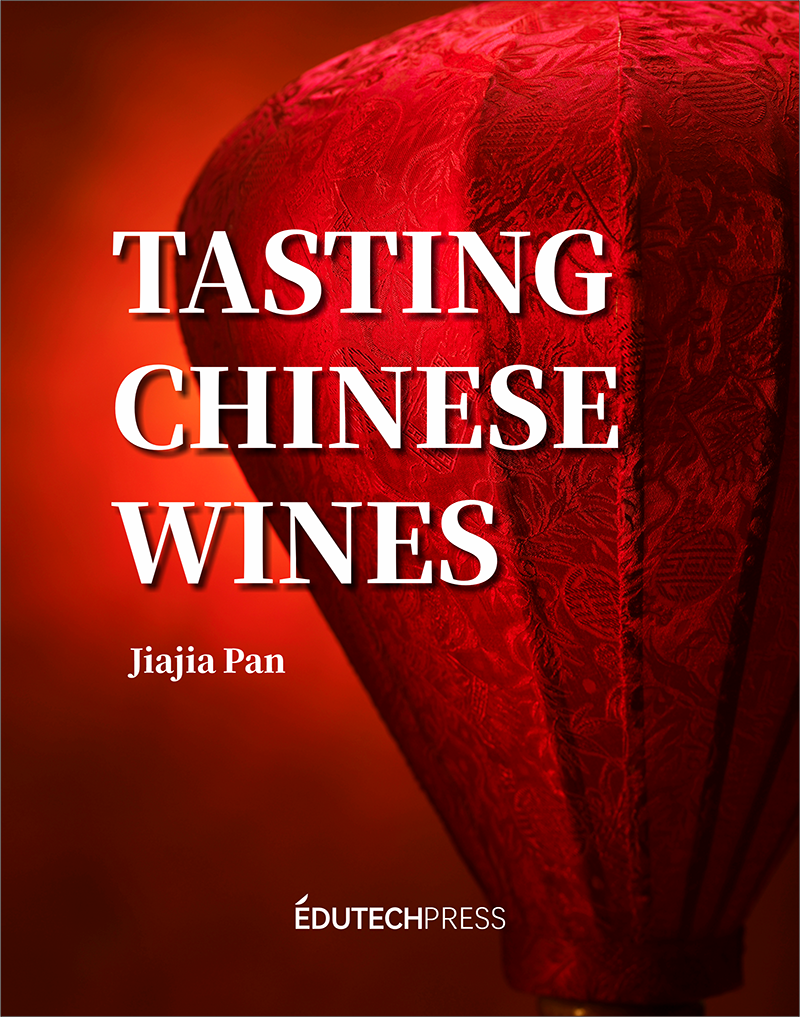
Tasting Chinese Wines is the world's first practical textbook on wine appreciation crafted from the perspective of Chinese culture. It pioneers the establishment of a localized wine appreciation system tailored to Chinese taste buds and cultural cognition, filling the void in the native discourse system dominated by Western appreciation standards. The book combines professional guidance, cultural subjectivity, and practical applicability, serving as an excellent learning tool for wine professionals, enthusiasts, catering industry practitioners, as well as faculty and students in academic institutions. It also stands as a vital vehicle for promoting the dissemination of Chinese wine culture and the development of the industry.
The book begins by systematically outlining the core wine-producing regions in China, ranging from the Gobi Desert terroir in the eastern foothills of the Helan Mountains in Ningxia to the maritime climate in Yantai, Shandong; from the remaining ranges of the Yanshan Mountains in Huailai, Hebei, to the sunlight advantages in the northern foothills of the Tianshan Mountains in Xinjiang; and further to the plateau characteristics of Diqing, Yunnan. It provides a detailed analysis of the terroir features, representative wineries, and typical wine styles of each region. Simultaneously, it focuses on native core grape varieties such as Cabernet Sauvignon, Cabernet Gernischt, Marselan, Longyan, and Italian Riesling, presenting in-depth their localized flavor expressions in different regions and constructing a foundational cognitive framework for readers on Chinese wines.
As a core highlight of the book, it creates an exclusive Chinese wine appreciation language system centered around the three major appreciation steps: "look, smell, and taste." In the color observation step, it innovatively introduces a wine color chart based on traditional Chinese colors, replacing obscure Western terminology to make color descriptions more aligned with the aesthetic and cognitive habits of the Chinese people. In the aroma identification step, it breaks through tradition by using commonly found Chinese spices, sauces, and floral and fruity scents such as Sichuan pepper, star anise, fermented broad bean paste, dried tangerine peel, and osmanthus to interpret wine aromas, awakening the unique olfactory memories of the Chinese and lowering the barriers to wine appreciation.
Building upon this foundation, the book further delves into professional dimensions of wine such as complexity, balance, tannin texture, and finish length, providing an advanced breakdown of appreciation techniques. It elaborates on key points such as flavor layers and aging potential, accompanied by practical training methods, to guide readers from novice to professional levels, enhancing their judgment and appreciation of wines.
Notably, the book bridges the gap between wine and Chinese culinary culture by systematically introducing the pairing logic between major Chinese cuisines, including Sichuan, Cantonese, Shandong, and Huaiyang, and local wines. It lists classic dishes from each cuisine, accurately matching them with wines from corresponding regions based on ingredient characteristics and flavor profiles, offering directly implementable pairing solutions. This transforms the concept of "pairing Chinese wines with Chinese dishes" from a mere notion into a practical culinary aesthetic.
This book is not merely a professional appreciation textbook; it embodies cultural confidence as its core philosophy, deeply integrating local terroir, traditional elements, and professional appreciation. It provides a localized professional methodology for wine appreciation, offers practical references for winery selection, restaurant wine list design, and sommelier services, and serves as a significant carrier for conveying the terroir charm and cultural connotations of Chinese wines to the world, facilitating the establishment and international dissemination of Chinese wine appreciation standards.
